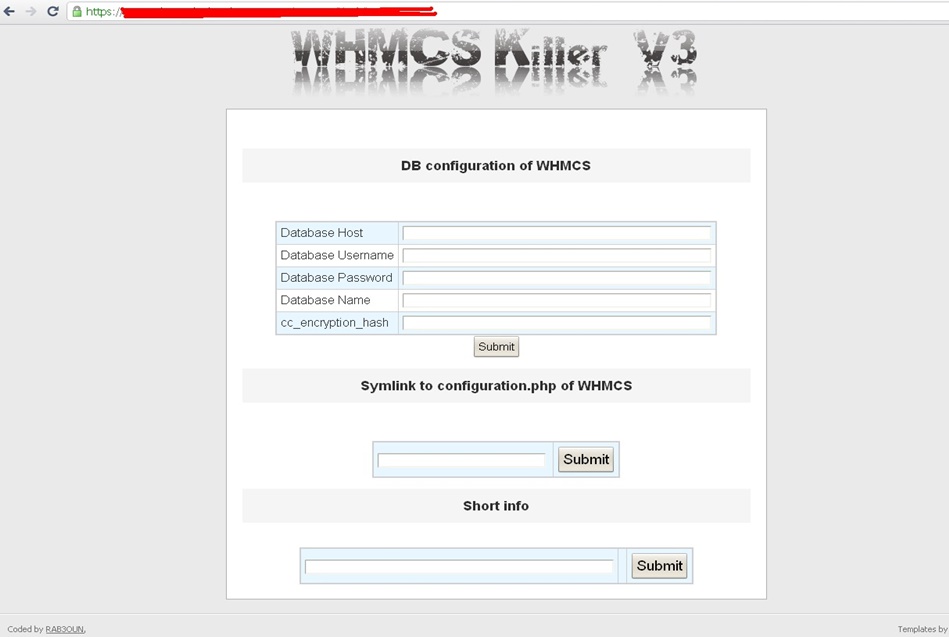
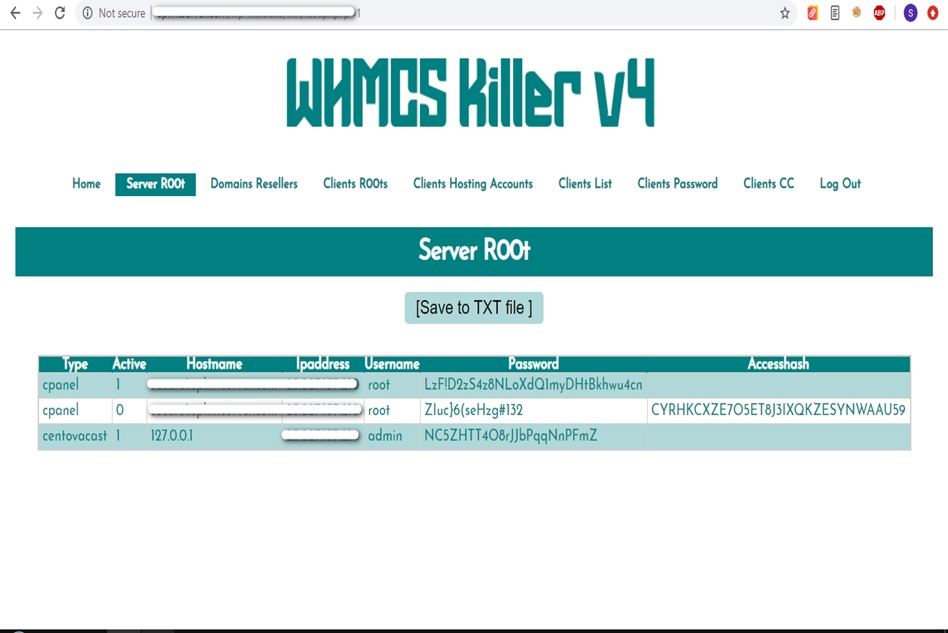
WHMCS Killer v4 Coded in Latest php version Tools Server R00t Domain Resellers Clients R00ts Clients Hosting Accounts Clients CC Clients Password NEw DEsign
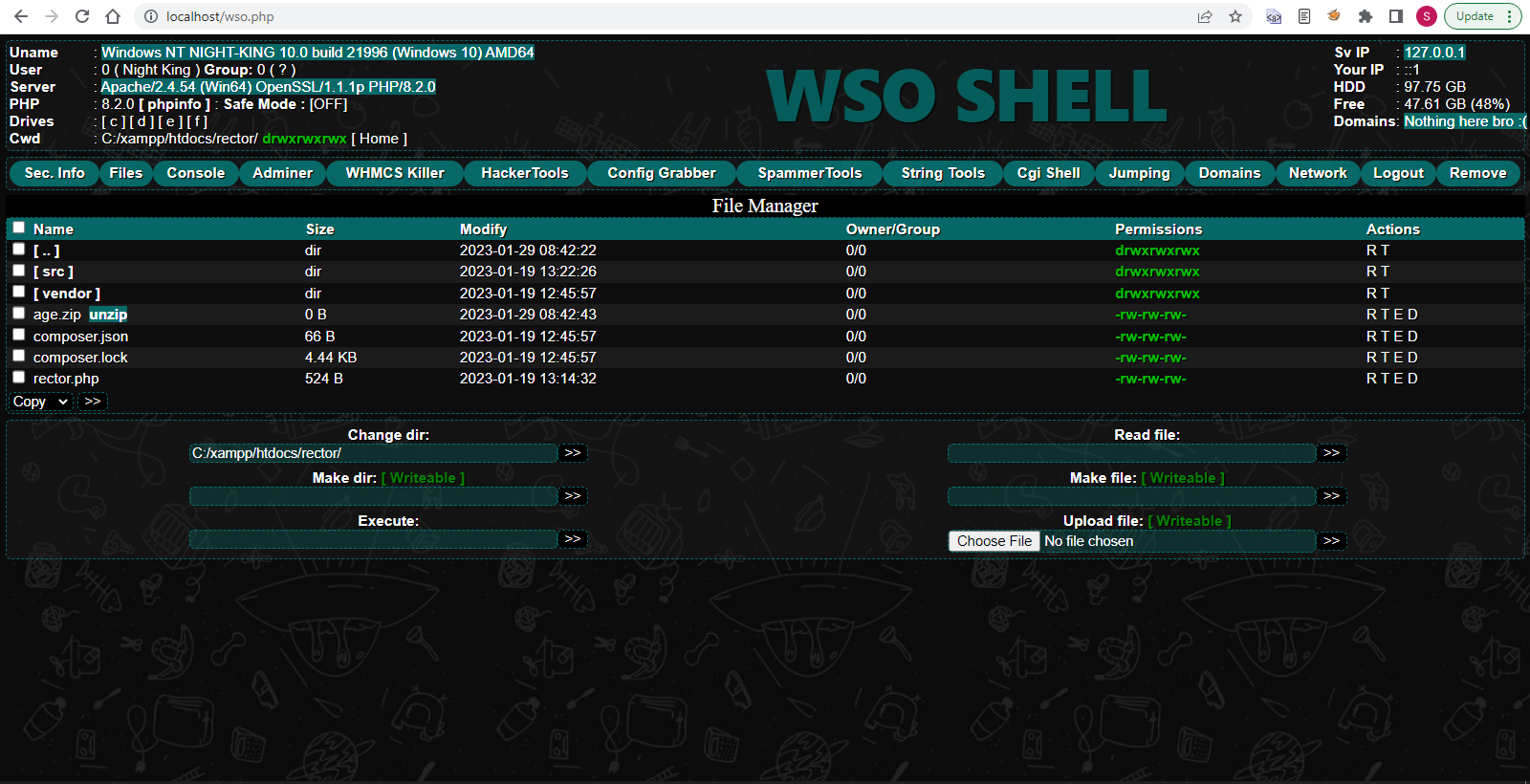
WSO SHELL 2023
[Hacker Tools] cPanel/WHM/WebMail Cracker - Create RDP - Getting Passwords - Finder .accesshash/WHM - Finder .my.cnf/cPanel - Auto Change Admin User WordPress/Joomla/OpenCart - Zone-h Poster - Install BackDoor [Spammer Tools] Create SMTP - Create Mailer - Mail Sending Checker - Redirects - Getting Emails-List - Emails-list Filter [Other Features] Adminer - WHMCS Killer v4 - Unzip - Config Grabber[Advanced] - Server Jumping - Cgi Shell - Back Connect - Domains List [Supported] php 5.x - php 7.x - php 8.x Password:dadsec
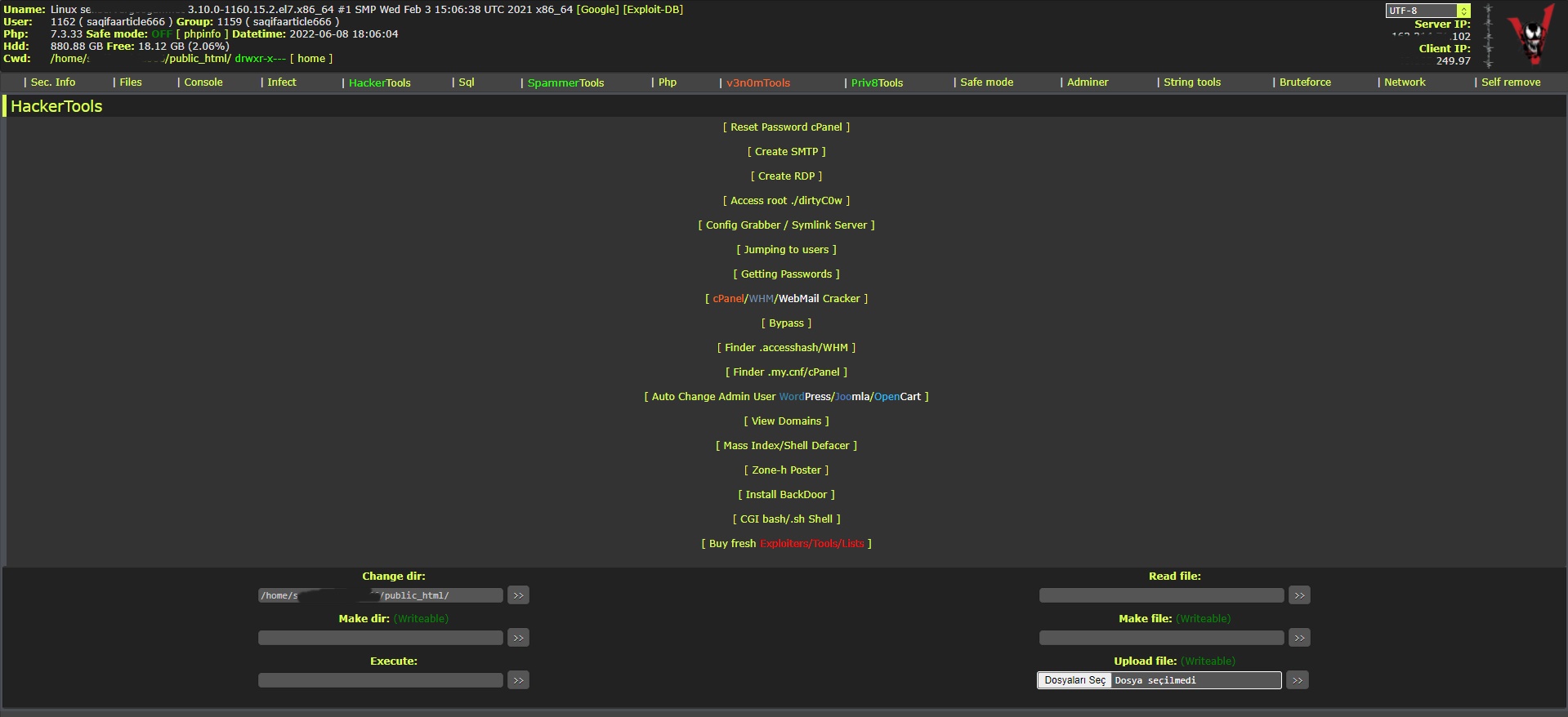
WAnonymousFox shell 2023
FoxAuto V8 [01] Mass Reset Password cPanel [02] Mass Finder SMTP + Create SMTP [03] Mass Finder Linux/Windows, cPanel/vHosts/Root [PWD|UNAME] [04] Mass Finder Accesshash [Reseller] + .my.cnf [cPanel] [05] Mass Get Config (cPanel/vHosts) server+Config404+ConfigCFS [06] Mass Get Config + Crack cPanel/WHM [07] Mass Get Config+Upload Shell on WordPress/Joomla/Opencart [08] Mass Get Root by ./dirty [PHP/BASH] [09] Mass Get RDP from Windows server [10] Mass Get Domains-List [11] Mass Get Emails-List [12] Mass Get Config + Emails-List [13] Mass Upload Mailer [Random] [14] Mass Upload File [Random] [15] Mass Upload Index + Post in Zone-h [16] Mass Upload Scam-Page/Zip-file + UNZip [17] Mass Check if Sending mail is Working or not! [Results delivery] [18] Mass Reports replacement Olux/xLeet/Other [19] From any Shell/UPloader, MASS Upload File Shell/Mailer [20] Reset Password cPanel + Finder/Create SMTP [together] [21] [All of them together] [22] Mass Finder SMTP + Create SMTP from cPanel [23] MASS Upload File Olux/xLeet/Other Shell/Mailer from cPanel [24] Mass Upload Scam-Page/Zip-file + UNZip from cPanel [25] Mass Check if Sending mail is Working or not! [Results delivery] [26] Mass Reports replacement Olux/xLeet/Other from cPanel [27] Mass login WordPress/Joomla/Opencart/Drupal + UPload Shell
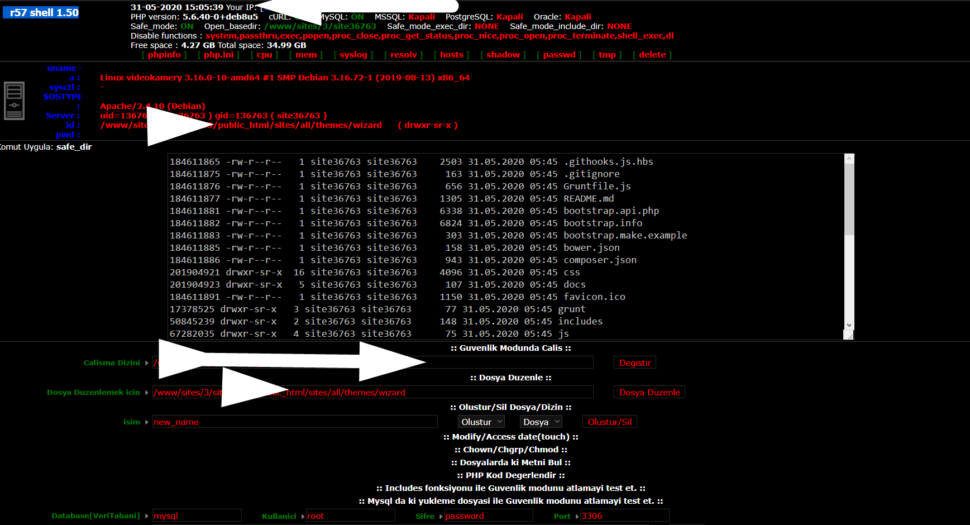
Wr57 shell txt
visit the most interesting R57 pages, well-liked by users from your country and all over the world, or check the rest of r57.biz data below. R57.biz is a website, reported to be malware-infected or hijacked, so you should stay away from it until the problem is resolved. We found that English is the preferred language on R57 pages. Their most used social media is Facebook with about 93% of all user votes and reposts.
user wants a long article for the keyword "password-find-plc siemens s7-keys7-v314-". This seems to be about password finding for Siemens S7 PLCs, possibly related to the KeyS7 tool (v3.14). I need to provide a comprehensive article. I will search for relevant information. search results provide some relevant pages. I need to open them to gather information for the article. search results provide information about KeyS7 and other password recovery methods. I will also search for "Siemens S7 password recovery software KeyS7" and "S7-300 password recovery KeyS7". search results provide some information. The user's keyword suggests they want an article about "password-find-plc siemens s7-keys7-v314-". This likely refers to a tool called KeyS7 version 3.14 for finding passwords on Siemens S7 PLCs. The article should cover what KeyS7 is, how it works, supported models, usage, legal/ethical considerations, and alternative methods. I will structure the article accordingly. Now, I will write the article. will now write a comprehensive article based on the gathered information. The article will cover: introduction, what is KeyS7 v3.14, supported PLC models, how to use, legal and ethical considerations, alternative official password recovery methods, conclusion.Navigating the Challenges of Siemens S7 PLC Password Recovery: A Deep Dive into KeyS7 v3.14 and Official Alternatives** In the dynamic world of industrial automation, few scenarios are as frustrating as being locked out of a programmable logic controller (PLC) due to a forgotten or lost password. For engineers maintaining legacy systems, acquiring second-hand equipment, or troubleshooting machines from a defunct integrator, this barrier can bring production lines to a grinding halt. For Siemens SIMATIC S7 series controllers, particularly the older S7-200, S7-300, and S7-400 families, password protection is a common measure for safeguarding intellectual property and system integrity. Among the various unofficial tools available, KeyS7 v3.14 —often associated with the search term "password-find-plc siemens s7-keys7-v314-"—has gained notoriety as a software utility designed to retrieve these access codes. This article provides a comprehensive examination of the KeyS7 tool, its functionality, supported hardware, step-by-step usage, the critical legal and ethical boundaries you must observe, and the official Siemens methods for password recovery. Understanding Siemens S7 Password Protection Levels Before delving into recovery methods, it's essential to understand how Siemens implements password security on its legacy S7 platforms. These protections are designed to control access to the CPU and prevent unauthorized operations. The S7-200, S7-300, and S7-400 series support varying levels of access protection, typically categorized as follows:
Level 1 (Full Access): No password is required. The user has complete read and write access to the program. Level 2 (Read-Only Access): A password is required for any write operation. Uploading (reading) the program is possible without a password, but downloading (writing) is restricted without the proper credentials. Level 3 (No Access): This is the highest restriction level. Both read and write operations are blocked. A password is necessary for any form of online access, making the program completely inaccessible without it. This level is typically used when the proprietary program logic itself is considered a trade secret.
It is this Level 3 protection that presents the greatest challenge, as it effectively renders the PLC a "black box" without the correct password. This is where tools like KeyS7 are sought after. What is KeyS7 v3.14? KeyS7 (version 3.14, specifically known as KeyS7_v314 ) is a third-party software tool developed to "find a PASSWORD in the CPU Simatic Siemens S7-200, 300 e 400". Unlike brute-force methods that try endless combinations, KeyS7 appears to exploit a known vulnerability in the challenge-response authentication protocol used by these legacy Siemens PLCs. The authentication mechanism for online access involves a handshake: the PLC sends a challenge to the programming device (PG/PC), which then sends back a response derived from the password. KeyS7 is designed to intercept and reverse-engineer this response to reveal the password. The tool's typical distribution package includes:
keys7.exe : The main executable to launch the password finding utility. Instructions.docx and Passo-a-passo.docx : Documentation (likely in multiple languages) guiding the user through the steps. log_keyS7.txt : A log file where the operation record, and presumably the found password, is written. simatic.dic and superdic.dic : Dictionary files. These are likely used as part of its attack methodology, containing a list of common passwords to accelerate the recovery process. readme_rus.chm : A Russian-language help file. password-find-plc siemens s7-keys7-v314-
Compatibility and Requirements One of the first things to understand about KeyS7 v3.14 is that it was developed for an older generation of hardware and software. According to its documentation, the tool has been tested on Windows XP. While it may run on newer operating systems with compatibility settings, users should not expect guaranteed stability. The tool's compatibility, as detailed in its description, is as follows: Supported PLCs:
Siemens Simatic S7-200 Siemens Simatic S7-300 Siemens Simatic S7-400
Important: For the newer S7-1200 and S7-1500 series, KeyS7 is not effective. These models use a more advanced, robust security architecture and are not vulnerable to this type of legacy authentication exploit. Official methods must be used for them. Supported Communication Protocols and Hardware (PG/PC Interfaces): user wants a long article for the keyword
PC Adapter (COM) : Standard serial programming cable. PC Adapter (USB) : The more modern USB programming adapter. CP5512 (PCMCIA) : A PCMCIA card used with older laptops. CP5611 (PCI) : A PCI card for desktop PCs. TCP/IP Ethernet Board : Standard Ethernet connection, set to "Auto" mode.
How to Use KeyS7 v3.14: A Methodological Overview The following steps provide a procedural overview of how the tool is typically utilized. It is imperative to remember that this tool should only be used on equipment you have explicit legal authority to access. Step 1: Environment Preparation Given its legacy nature, the most reliable setup is a Windows XP environment. If using a newer Windows version, consider using a virtual machine (e.g., VirtualBox or VMware) with a Windows XP guest OS for maximum compatibility. Ensure that the appropriate drivers for your programming interface (e.g., PC Adapter USB, CP5611) are correctly installed in this environment. Step 2: Establishing Physical Connection Power on the Siemens S7 PLC. Connect your PG/PC to the CPU using one of the supported communication methods (e.g., MPI, Profibus, or Industrial Ethernet). For a standard S7-300, this often means using a PC Adapter connected to the MPI port. Step 3: Running the KeyS7 Tool Launch the keys7.exe application. The interface is typically a simple dialog box where you will need to configure the connection parameters. Step 4: Configuring Communication Settings You must match the tool's communication settings to your physical setup. This includes:
Selecting the correct interface (e.g., PC Adapter, TCP/IP). Setting the correct PLC node address (e.g., MPI address of the CPU, often address 2 for S7-300/400). Setting your PG/PC node address (must be unique on the network). Selecting the correct transmission rate (e.g., 187.5 Kbps for MPI). I will search for relevant information
Step 5: Running the Recovery Process Once parameters are set, initiate the connection. The tool will attempt to communicate with the PLC and exploit the authentication challenge. The process may take some time, depending on the password complexity and the method used. Step 6: Obtaining the Result Upon success, the tool should log the found password. According to the package contents, this may be written to the log_keyS7.txt file in the tool's directory. You should then be able to use this recovered password with Siemens' official STEP 7 software to access the PLC. Legal and Ethical Considerations: A Critical Warning This section cannot be overstated. The use of tools like KeyS7 exists in a complex and often illegal or unethical space.
Intellectual Property Violation: The passwords on an S7 PLC protect the program logic, which is the intellectual property of the original machine builder or engineer. Bypassing this protection is akin to breaking a digital lock and is a violation of copyright and trade secret laws. Siemens' official forums explicitly state that "breaking password here in this case is illegal". Permissible Scenarios: Legitimate use cases are very narrow. They are generally considered acceptable only when you are the legal owner of the equipment and the program, and you have lost your own password. Another scenario is when a third-party integrator has gone out of business or is unresponsive, and you need to recover a machine essential for production. In such cases, it is always best to first seek legal advice. Professional Consequences: Unauthorized access and password bypass could lead to severe professional repercussions, including termination of employment, lawsuits, and damage to professional reputation.